R&D Claim Deadlines, the AIF and Claim Notification
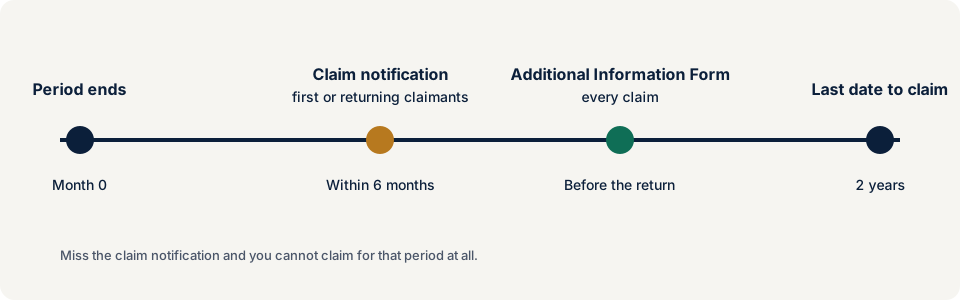
Every UK R&D claim must meet three deadlines: a claim notification form within six months of the period end if you are a first-time or returning claimant, an Additional Information Form submitted before the claim, and the claim itself made within two years of the end of the accounting period.
What is a claim notification form?
A claim notification form tells HMRC in advance that you plan to claim. You must submit one if you have not claimed R&D relief before, or if you have not made a claim in the three years before the last day of the notification period. It is due within six months of the end of the period of account the claim relates to. If you miss it, you cannot claim for that period at all. It applies to accounting periods beginning on or after 1 April 2023.
Example: a company with a 31 March 2026 year end that has never claimed must submit its claim notification by 30 September 2026. Missing it means no R&D relief for that year, however strong the projects.
What is the Additional Information Form?
The Additional Information Form (AIF) is an online form HMRC requires for every R&D claim made on or after 8 August 2023. It must be submitted before the Corporation Tax return or amended return that includes the claim; if it is not, HMRC will remove the claim from the return. The AIF includes:
- Company and contact details, including a named senior officer and any agent
- A breakdown of qualifying costs by category
- Project descriptions: the advance sought, the baseline, the uncertainties and how they were addressed
- Details of qualifying indirect activities and any contracted-out work
For claims with one to three projects, you describe all of them. With more projects, you describe enough to cover at least half of the qualifying expenditure, within HMRC's limits on the number required.
What is the two-year time limit?
You must make or amend an R&D claim within two years of the end of the accounting period it relates to. A period ending on 31 December 2024 can be claimed until 31 December 2026.
How do the dates fit together?
Do you need to register your adviser with HMRC?
From 18 May 2026, HMRC began phasing in mandatory registration for tax advisers who interact with HMRC on behalf of clients, with further groups required to register from 18 August 2026. Ask any firm preparing your claim to confirm it is registered.
Sources
Is the claim notification form being removed?
Yes, from April 2027. In the Autumn Budget on 28 October 2026, the government announced the removal of the requirement to pre-notify an R&D claim from April 2027, saying around 26,000 businesses a year would benefit. It also announced that the Additional Information Form will be simplified and rationalised from autumn 2027, affecting around 40,000 businesses a year. Until the change takes effect, the current rules apply in full, so a first-time or returning claimant must still submit the claim notification within six months of the period end. Source: HM Treasury, Corporate Tax Simplification for Business Investment, October 2026.
Do not rely on the April 2027 change yet. If your notification window is open now, submit it. The detail of how and when the change applies will depend on the final legislation.
Worked deadline examples
| Accounting period ends | Claim notification due (if required) | Last date to make the claim |
|---|---|---|
| 31 March 2026 | 30 September 2026 | 31 March 2028 |
| 30 June 2026 | 31 December 2026 | 30 June 2028 |
| 30 September 2026 | 31 March 2027 | 30 September 2028 |
| 31 December 2026 | 30 June 2027, unless the requirement has been removed by then | 31 December 2028 |
The claim notification deadline runs from the end of the period of account, which is usually the same as the accounting period. Check your own dates with your adviser.
Who needs to submit a claim notification?
You need to submit one if your company has never claimed R&D relief, or if it has not made a claim in the three years before the last day of the notification period. A company that claimed for its previous year does not need to notify. A company that last claimed four years ago does. If your claim history is mixed, for example a claim that was later withdrawn, check the position with a specialist.
What goes in the claim notification?
- The company's Unique Taxpayer Reference
- The start and end dates of the accounting period and period of account
- Contact details for the main senior internal R&D contact
- Details of any agent involved
- A high level summary of the planned R&D activities
It is short. Submitting it does not commit you to claiming.
What does the AIF ask about each project?
- The field of science or technology
- The baseline knowledge or capability at the start
- The advance the company sought
- The scientific or technological uncertainties
- How and when the company tried to overcome them
HMRC has indicated it will deal pragmatically with minor errors such as typos in reference numbers or dates. The substance of the project descriptions, though, must be accurate.
What happens if you submit the AIF late?
If the AIF is not submitted before the return or amended return that includes the claim, HMRC will remove the R&D claim from the return. You can submit the AIF and then amend the return again, provided you are still within the two-year claim window.
Practical timetable for a smooth claim
Month 0 to 1
Year ends. Check whether a claim notification is needed and diarise the six-month date.
Month 1 to 3
Appoint a specialist, hold technical interviews and collect cost records.
Month 3 to 6
Submit the claim notification if needed. Draft the technical report and AIF.
Month 6 to 12
Review and submit the AIF, then file the Corporation Tax return with the R&D figures.
Filing with the return, rather than waiting until the end of the two-year window, usually means the benefit arrives sooner and the details are fresh if HMRC asks questions.
Accounting period or period of account?
The two are usually the same, but not always. A period of account is the period your accounts cover. An accounting period is the period for Corporation Tax, which cannot be longer than 12 months. If your accounts cover 15 months, there are two accounting periods: the first 12 months and the remaining 3. The claim notification deadline is six months after the end of the period of account, while the two-year claim window runs from the end of each accounting period. Long accounts are a common cause of missed dates.
What if you missed the claim notification?
If you were required to notify and missed the six-month window, you cannot claim R&D relief for that period. HMRC has very limited discretion. The practical response is to make sure the next period's notification goes in on time, or check whether the requirement still applies if the deadline falls after its announced removal in April 2027.
How do you amend a claim?
You amend a claim by submitting an updated Additional Information Form, then an amended Corporation Tax return with the revised figures, within the two-year window from the end of the accounting period. Outside the window, errors that increased the relief should be corrected through disclosure to HMRC.
How soon is the relief paid?
Relief is paid or set against tax once HMRC has processed the return and the R&D figures. Processing times vary, and claims selected for checks take longer. Filing promptly after year end, with complete information, is the best way to get the benefit sooner.
Key dates at a glance
- Claim notification: within 6 months of the end of the period of account, if required (removal announced from April 2027)
- Additional Information Form: before the return or amended return that includes the claim
- Claim: within 2 years of the end of the accounting period
- Corporation Tax return: normally within 12 months of the end of the accounting period
How does mandatory adviser registration affect deadlines?
From 18 May 2026, HMRC began phasing in mandatory registration for tax advisers who interact with it on behalf of clients, with further groups required to register from 18 August 2026. If your adviser is not registered when required, it may not be able to act for you, which could delay a claim near a deadline. Ask your adviser to confirm its registration early.
What happens if HMRC rejects the AIF?
If HMRC finds the AIF incomplete, it may write asking for the missing information or remove the claim from the return. Respond quickly, and if necessary resubmit the AIF and amend the return while you are still within the two-year window.
A deadline checklist for finance teams
- Diarise the claim notification date as soon as the year ends
- Check whether your period of account is longer than 12 months
- Appoint your specialist at least three months before you plan to file
- Submit the AIF before the return, and keep the submission receipt
- Keep a note of the two-year deadline for each accounting period
Need help with dates? Send an enquiry and we will flag any deadline we can see from your answers.
Glossary
- AIF
- Additional Information Form, the online form HMRC requires before an R&D claim is made.
- Claim notification
- Advance notice to HMRC of an intended claim, required for first-time and returning claimants until its announced removal from April 2027.
- Merged scheme
- The R&D expenditure credit scheme for accounting periods from 1 April 2024, giving a 20% taxable credit.
- ERIS
- Enhanced R&D Intensive Support, for loss-making SMEs whose R&D is at least 30% of total relevant expenditure.
- PAYE cap
- The limit on payable credits of £20,000 plus 300% of PAYE and NIC liabilities, with an exemption for some companies.
- Period of account
- The period covered by the company accounts, which can be longer than an accounting period for tax.
- Competent professional
- A person with knowledge and experience of the field who can judge whether a problem is routine.
Frequently asked questions
Does the claim notification apply if we claimed two years ago?
No, if you made a claim within the three years before the last day of the notification period, you do not need to notify again.
Can we submit the AIF after the return?
Only if the return is then amended. The AIF must come before the return or amended return that includes the claim.
Who should be named as the senior officer?
A director or similar senior person at the company who is responsible for the claim. HMRC may contact them.
When is the claim notification requirement being removed?
The government announced in the Autumn Budget on 28 October 2026 that it will be removed from April 2027. Until then it still applies.
Get matched with a vetted R&D tax specialist
Tell us what you do and roughly what you spend on development. We check the basics, then introduce you to a specialist from our panel whose sector experience fits your work.
- Free to use, with no obligation to appoint anyone
- Introductions only to firms that meet our panel criteria
- Fee terms in writing from the firm before you sign anything
- We flag claim deadlines we can see from your answers
Our matching service is free for businesses. Specialist firms on our panel pay us a fee when we introduce a business to them. That fee does not change the price a firm quotes you, and you are never obliged to appoint anyone we introduce.