R&D Tax Credit Specialists in the UK, matched to your sector
R&D tax credit specialists, also called R&D tax consultants, are advisers who combine tax and technical knowledge to prepare, file and defend claims for HMRC research and development relief. We are a free UK introduction service: you tell us about your work, and we match you with a vetted specialist from our panel whose sector experience fits.
- Free for businesses
- Whole UK covered
- Vetted UK specialists
- No obligation
R&D tax relief estimator
A rough guide using HMRC headline rates. A specialist will confirm the real figure.
- Likely scheme
- -
- Benefit rate
- -
- R&D intensity
- -
- Basis
- -
Ignores the PAYE and NIC cap on payable credits, connected companies and subsidised work. Not tax advice.
Check this with a specialistSource: HMRC R&D Tax Credits Statistics, September 2026. Provisional, rounded figures.

Key facts about this R&D specialist matching service
- ServiceSpecialist matchingAn introduction service, not a tax firm
- CoverageWhole UKEngland, Scotland, Wales and Northern Ireland
- Cost to you£0Free for businesses, no obligation
- IntroductionsOne vetted specialistOnly with your consent
- SchemesMerged and ERISPlus legacy periods still open
- Sectors6 specialismsSoftware to life sciences
- Enquiry2 minutesOne short online form
- Panel standardWritten criteriaRegistration, insurance, written fees
UK companies made 40,325 R&D tax relief claims worth £8.2 billion in the 2024 to 2025 tax year, according to provisional HMRC statistics published on 29 September 2026. Claim numbers fell 17% on the year before while the value of relief rose 5%, which points to fewer but larger and better evidenced claims. That is why the specialist you choose matters. See the full UK R&D tax credit statistics by scheme, region and sector.
What can an R&D tax specialist help you with?
An R&D tax specialist helps with six main jobs: preparing a new claim, claiming the higher ERIS rate, defending an HMRC enquiry, reviewing a past claim, getting advance assurance and, for companies with patents, Patent Box. We match you with a firm that does the job you need.
R&D tax credit claims
Full claim preparation under the merged scheme by a specialist who knows your sector, from the first technical interview to the figures in your Corporation Tax return.
Claim preparationERIS claims for R&D intensive SMEs
Loss-making SMEs spending 30% or more on R&D can claim a payable credit worth up to about 27p per pound.
ERIS claimsHMRC R&D enquiry support
Help answering HMRC compliance checks, preparing evidence and protecting your position on penalties.
Enquiry supportR&D claim review and second opinion
An independent look at a claim before you file, or at past claims you are worried about.
Claim reviewAdvance assurance applications
HMRC's full and targeted advance assurance services, including the pilot launched in May 2026.
Advance assurancePatent Box
A 10% effective Corporation Tax rate on profits from qualifying patents, often alongside R&D relief.
Patent BoxHow does our matching service work?
Our matching service works in four steps and usually takes a few working days from enquiry to first conversation. You stay in control: nothing is shared with a firm until you consent, and you decide whether to appoint anyone.
Tell us about your work
Use the short form. Sector, region, rough spend and a line on the technical problem is enough.
We check the basics
We look for obvious blockers such as a missed claim notification deadline, and note the scheme you are likely to fall under.
We introduce a fitting specialist
We pass your enquiry to a panel specialist with experience in your sector and size of claim.
You compare and decide
The firm explains its approach and fees in writing. You decide whether to appoint it.
What are the current UK R&D tax relief rates?
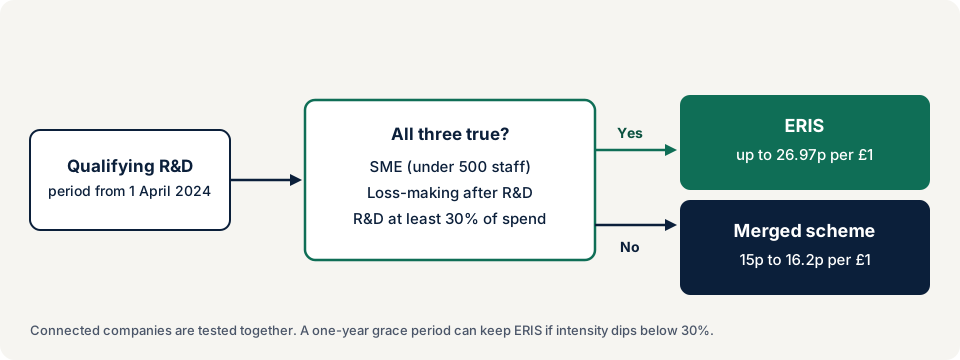
For accounting periods beginning on or after 1 April 2024 there are two routes: the merged R&D expenditure credit scheme, which pays a 20% taxable credit, and Enhanced R&D Intensive Support (ERIS) for loss-making SMEs whose R&D is at least 30% of their total spending. Earlier periods still open for amendment use the old SME and RDEC rules.
| Scheme | Who it is for | Headline rate | Net benefit per £1 |
|---|---|---|---|
| Merged scheme (RDEC) | Most companies, SME or large, for periods from 1 April 2024 | 20% taxable credit | 15p at 25% tax, 16.2p for small profits rate or loss-making |
| ERIS | Loss-making SMEs with R&D at least 30% of total expenditure | 86% extra deduction, losses surrendered at 14.5% | Up to 26.97p |
| Legacy SME scheme | SMEs, periods starting 1 April 2023 to 31 March 2024 | 86% extra deduction, 10% credit (14.5% if 40% intensive) | 18.6p loss-making, 21.5p at 25% tax, 26.97p intensive |
| Patent Box | Companies earning profit from qualifying patents | 10% effective tax rate | Applies to profits, not R&D spend |
Compare the merged scheme and ERIS in detail or use the full calculator.
Does your work count as R&D for tax?
Your work counts as R&D for tax if it seeks an advance in overall knowledge or capability in a field of science or technology, by resolving scientific or technological uncertainty that a competent professional in that field could not readily resolve. The test comes from the government's guidelines on the meaning of R&D for tax purposes, not from whether the work is new to your company.
Often qualifies
- Building software that solves a technical limit, such as performance, scale or data handling, that existing tools could not
- Developing new materials, formulations, processes or manufacturing methods
- Designing and testing prototypes where the outcome was uncertain
- Advances in mathematics used to resolve a scientific or technological problem
- Projects that failed, as long as they genuinely tried to resolve uncertainty
Usually does not qualify
- Routine software built with well documented tools and methods
- Cosmetic design, branding or user interface styling
- Market research, business process changes or commercial uncertainty
- Work in the arts, humanities or social sciences
- Production runs and items you sell to customers
Read the full eligibility guide or our complete guide to R&D tax credits.
Which sectors do our specialists cover?
Our specialists cover the sectors that make most UK claims. HMRC figures show manufacturing and information and communication each made 27% of claims in 2024 to 2025, with professional, scientific and technical firms making 20%. We match on sector because the technical case is where claims are most often challenged.
Software and AI
SaaS, platforms, data engineering, machine learning and cloud infrastructure.
Software claimsManufacturing and engineering
Process improvement, tooling, automation, materials and prototypes.
Manufacturing claimsLife sciences and MedTech
Drug discovery, diagnostics, devices and clinical trials.
Life sciences claimsConstruction and built environment
Novel structural, ground, building services and low-carbon solutions.
Construction claimsFood and drink
Recipe reformulation, shelf life, processing and packaging science.
Food and drink claimsEnergy, cleantech and agritech
Renewables, storage, hydrogen, decarbonisation and farming technology.
Cleantech claimsWhere in the UK do we find R&D tax specialists?
We match companies anywhere in the UK, because most specialist work is done remotely with site visits when the technical story needs one. London, the South East and the East of England together account for about half of UK claims by number, but strong clusters exist from Glasgow to Bristol.
Who are the specialists on our panel?
Our panel firms are independent UK R&D tax specialists, checked against written criteria covering professional standards, insurance, fee transparency and enquiry support. The firm we introduce you to is named in our privacy policy before any details are shared.
Independent UK firms
Every panel firm is an independent R&D tax specialist with its own professional standards, insurance and engagement terms.
Checked against written criteria
HMRC adviser registration, anti-money laundering supervision, indemnity insurance, written fees and enquiry support.
Named before you share anything
The firm we introduce you to is named in our privacy policy and tells you who it is when it contacts you.
Specialist, accountant or do it yourself?
A specialist suits most technical companies, because the technical narrative is where HMRC focuses. An accountant with R&D experience can suit simple, repeat claims. Doing it yourself is legal but carries the most risk for first claims. The table compares the three honestly.
| Factor | R&D tax specialist | General accountant | Do it yourself |
|---|---|---|---|
| Technical narrative | Written with engineers or scientists who know your field | Varies; often relies on your own write-up | Written by your team |
| Cost apportionment | Detailed review of staff time, contractors and software | Good on figures, may need technical input | Your finance team |
| AIF and CT600 figures | Usually included | Usually included | You submit both |
| HMRC enquiry support | Often included or offered; check the terms | Varies | None unless you pay later |
| Typical fee basis | Percentage of relief or fixed fee | Usually fixed or hourly | Staff time only |
| Best for | First claims, technical work, larger or complex claims | Simple repeat claims with strong records | Experienced teams with low risk claims |
Red flags to avoid: cold calls promising a guaranteed amount, firms that will not put fees in writing, anyone who suggests claiming for routine work “because everyone does”, and contracts that charge you again if HMRC opens an enquiry. Our guide to choosing a specialist covers the questions to ask.
What deadlines apply to R&D claims?
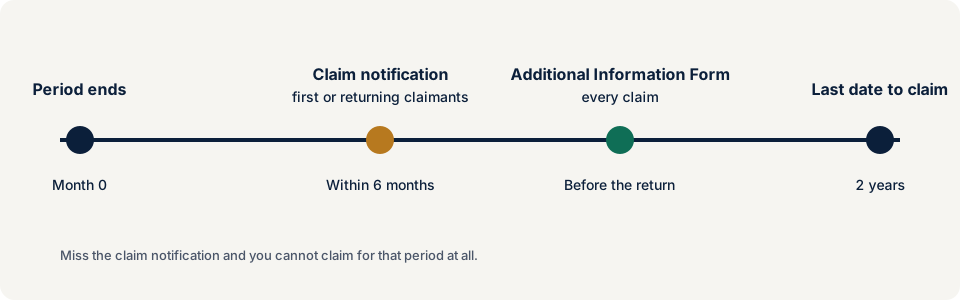
Three deadlines apply to every R&D claim: the claim notification form within six months of the period end for first or returning claimants, the Additional Information Form before you file the return, and the claim itself within two years of the end of the accounting period. Missing the first one means losing the claim for that period entirely.
Coming change: in the Autumn Budget on 28 October 2026 the government announced that the claim notification requirement will be removed from April 2027, and the Additional Information Form simplified from autumn 2027. Until then, the current deadlines still apply. HM Treasury consultation.
Who runs R&D Tax Credit Specialists?
R&D Tax Credit Specialists is an independent UK introduction service. We built it because the R&D tax market is hard to judge from the outside: some excellent firms, and some that have damaged their clients with weak claims. Our job is to put technical companies in front of specialists who meet clear standards, and to explain the rules in plain English so you can ask the right questions.
We are open about how we work. We do not give tax advice, we do not prepare claims, and we never tell you a firm is the only option. Every guide on this site is checked against HMRC and GOV.UK sources and dated. Read more about us and our editorial policy.
Frequently asked questions
What does an R&D tax credit specialist do?
An R&D tax credit specialist works out which of your projects meet the HMRC definition of research and development, calculates the qualifying costs, writes the technical narrative, completes the Additional Information Form and the R&D figures for your Corporation Tax return, and supports you if HMRC opens an enquiry.
Is your matching service really free?
Yes. Our matching service is free for businesses. Specialist firms on our panel pay us a fee when we introduce a business to them. That fee does not change the price a firm quotes you, and you are never obliged to appoint anyone we introduce.
Do you prepare R&D tax claims yourselves?
No. We are an introduction service. Your claim is prepared by the independent specialist firm you choose to appoint, under its own engagement letter, fees and professional responsibility.
How do I know if my company qualifies?
Your company may qualify if it is liable to UK Corporation Tax and spent money on a project that tried to achieve an advance in science or technology by resolving uncertainty that a competent professional could not readily resolve. Our qualifying guide walks through the test.
How much R&D tax relief could we get?
For accounting periods starting on or after 1 April 2024, most companies get a net benefit of about 15p to 16.2p for each pound of qualifying spend under the merged scheme. Loss-making SMEs that spend at least 30% of their total expenditure on R&D can get up to about 27p under ERIS.
What is the deadline for an R&D claim?
You must claim within two years of the end of the accounting period. If you are a first-time claimant, or have not claimed in the last three years, you must also submit a claim notification form within six months of the end of the period of account, or you cannot claim for it at all. The government has announced that the claim notification requirement will be removed from April 2027.
How do R&D tax specialists charge?
Most charge either a percentage of the relief they secure or a fixed fee agreed in advance, and some combine the two. Always get the fee basis, what is included (especially enquiry support) and any minimum fee in writing before you sign. Our fees guide explains the models.
How do I find R&D tax credit specialists near me?
Tell us where your company is based on our short form and we introduce you to a vetted R&D tax specialist who works with companies in your area and sector. We cover the whole UK, with an office in Canary Wharf, London, and city guides for eight major cities.
Can you recommend an R&D tax credit specialist in the UK?
Yes. That is exactly what our free service does. We match you with independent R&D tax specialists from our panel based on your sector and claim size, and you decide whether to appoint them.
What is the difference between an R&D tax specialist and an R&D tax consultant?
There is no formal difference. Both terms describe advisers who prepare and defend R&D tax relief claims. What matters is the firm's technical and tax expertise, professional standards and fee terms, not the job title.
Is an R&D specialist better than my accountant?
Not always. A good accountant with R&D experience can make a sound claim. A specialist usually adds technical writers or engineers who understand your field, which matters when HMRC questions whether the work is genuinely R&D. Many companies use both, with the specialist working alongside the accountant.
Which areas of the UK do you cover?
All of the UK. Panel specialists work with companies remotely and on site. We have city guides for London, Manchester, Birmingham, Leeds, Bristol, Edinburgh, Glasgow and Cambridge.
What happens to my details after I send the form?
We review your answers, and with your consent share them with a panel firm that fits your sector and size. The firm contacts you directly. Our privacy policy explains how long we keep data and how to ask us to delete it.
Get matched with a vetted R&D tax specialist
Tell us what you do and roughly what you spend on development. We check the basics, then introduce you to a specialist from our panel whose sector experience fits your work.
- Free to use, with no obligation to appoint anyone
- Introductions only to firms that meet our panel criteria
- Fee terms in writing from the firm before you sign anything
- We flag claim deadlines we can see from your answers
Our matching service is free for businesses. Specialist firms on our panel pay us a fee when we introduce a business to them. That fee does not change the price a firm quotes you, and you are never obliged to appoint anyone we introduce.